You only need a few things to start playing
-
If you’re playing in person, writing materials, paper, and standard gaming dice (including the percentile dice). Ideally every player will have their own set of dice, but you can share.
-
Next, you’ll need somewhere to play. If you’re playing in person, a table and comfortable
seating for everyone is a must. If you’re playing online, use the voice and/or video
program of your choice. Age of Vikings is available on online game platforms such as Foundry, Quest Portal and Roll20. -
You’ll need to set aside enough time to play, so plan to spend two to four hours having an adventure with your friends.
-
Finally, you’ll need to decide who you want to play with. A group between three and five players, one of whom must be the gamemaster, is ideal.
Once all that’s done, you’re ready to play!
Your Viking Heroes
Adventures in Age of Vikings revolve around heroic Vikings in mythic Iceland around 977 A.D. The world is full of vicious monsters, strange magic, dangerous mysteries, and tests of valor. Iceland is a rugged frontier land with no kings, no cities, no powerful guilds. The life of a Viking hero consists of balancing family politics with oaths sworn to preserve honour, forging friendships and alliances to defend against outlaws, and praying to the gods for protection against monsters and spirits.
Survival in such a land, perched on the very edge of the known world, requires cooperation. A viking’s reputation is their greatest asset. It gets them food when they’re hungry, medicine when they’re sick, aid when they’re under attack, and shelter in a storm. It can earn the favor of a god or the malice of a prophet. If they manage it poorly, it could doom them instead.
Heroes in Age of Vikings earn their reputation by taking bold action to defend themselves and their neighbors.
Heroes risk their lives for their communities, hoping that their neighbors might someday return the favor. They seek glory and honor so that skalds, heroic travelling poets, will someday compose a saga about them and that their names might ring out for the rest of time.
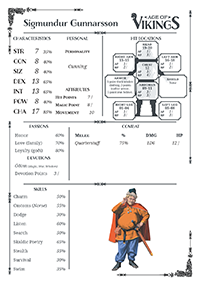
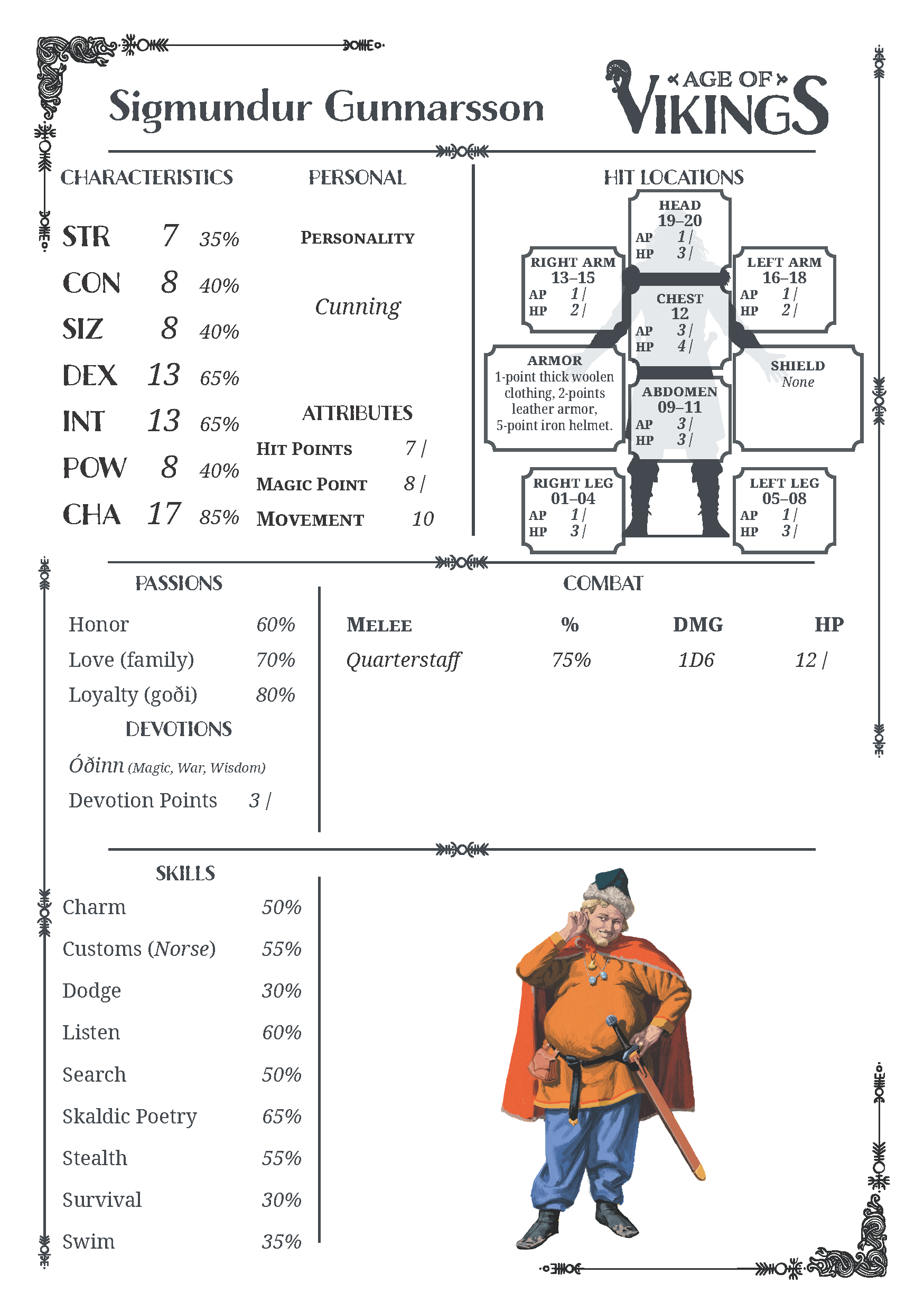
Your hero sheet records your hero’s strengths and weaknesses and tells the story of how they protect that which they value.
To help you get started, the Age of Vikings Quickstart provides you with four pre-generated heroes so you can jump straight into playing. The hero sheet is smaller and more compact than those presented in the full game.
Quickstart Pre-Generated Heroes
Four pregenerated hero characters to enable you and your friends to leap straight into the action!
These rules are summarized from the Age of Vikings core book, simplified for ease of play.
Characteristics
Seven characteristics define every hero, demonstrating how strong, fast, clever, and healthy they are. Characteristics are listed on the top left of the hero sheet. Each characteristic has a value between 3 and 18. This value determines various secondary characteristics (such as hit points and combat damage modifier). A characteristic roll, equal to the characteristic ×5, is used to determine the chance of success or failure of an action related directly to that characteristic.
- Strength (STR) represents physical prowess: how much your hero can lift and how hard they can hit.
- Constitution (CON) represents health and hardiness: how well your hero can fight off disease or poison, and keep up physical exertion before becoming exhausted.
- Size (SIZ) represents your hero’s height, build, and mass: how high or far they can reach, how heavy they are, and their general physique.
- Dexterity (DEX) represents speed and finesse: how quickly your hero can react to danger, their hand-eye coordination, and if they can keep a steady hand.
- Intelligence (INT) represents memory and raw acumen: how well your hero can remember details and how quickly they can pick up new types of knowledge.
- Power (POW) represents your hero’s willpower and inner drive: how lucky they are, their affinity for magic, the strength of their spirit, and how resistant they are to hostile supernatural powers.
- Charisma (CHA) represents personal magnetism and charm: your hero’s ability to convince others to follow them into danger or coerce others to get their way.
Personal
Found at the top-centre of your hero sheet, personal details include things like your hero’s name, age, gender, nickname, and reputation. Some of these are not relevant to the quickstart adventure.
Attributes
Attributes are in the center of your sheet. These are important values that often change during play.
- Hit Points - When your hero suffers damage, subtract that damage from their hit points. If your hero drops to 1 or 2 hit points, they fall unconscious and are at risk of dying. If a turn ends and your hero is at 0 hit points, they die.
- Movement - This value determines the distance your hero covers in a turn. Movement is measured in meters or yards, generally used interchangeably.
Skills
Your hero’s skills and associated values are at the bottom of the hero sheet. Each skill is rated as a percentage, representing your hero’s chances of succeeding at an action using that skill. If a die roll is equal to or less than the skill’s percentage rating, and no force is working against it, the skill attempt succeeds.
Combat
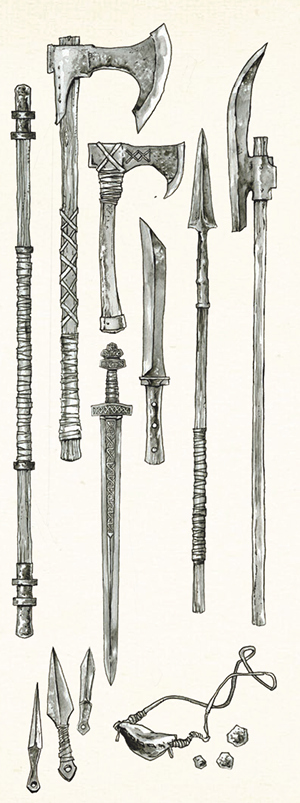
The combat section is in the center of your hero sheet. Here you’ll find the different weapons your hero can use, their chances to hit an enemy with their weapons, and the damage they inflict when they successfully strike a foe.
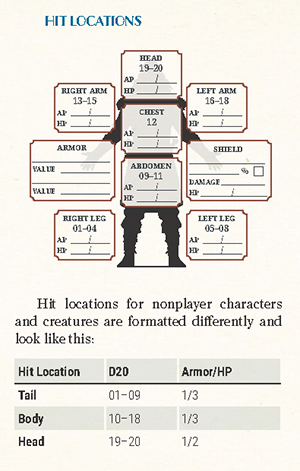
- Hit Locations - On the top-right of your hero sheet are their hit locations. These come into play when they are under attack from enemies. Hit locations divide the body into parts, each with its own number of hit points. If a hit location suffers more damage than it has, it is disabled.
- Armor value describes how much armor each hit location has.
Your Viking Hero
System & Skills
Whenever your hero attempts something dangerous, dramatic, or has consequences for failure, make a skill roll. There is no need to roll for ordinary actions such as walking along the beach, boarding a ship, or climbing a ladder. Circumstances can often turn normal actions dangerous, however: sneaking to the site of a raid and avoiding the attention of guards, boarding a ship during a violent storm, or climbing a rocky, crumbling cliffside in the rain all become more dramatic, with the consequences of failure much greater.
Making Skill Rolls
To make a skill roll, tell the gamemaster what your hero is trying to accomplish (for example, leaping aboard a ship in the middle of a storm). In most cases the relevant skill is obvious, but if there is any doubt, the gamemaster decides which skill is appropriate and whether there’s any bonus (due to beneficial circumstances) or penalty (due to distractions or extra danger). Skills are rated with a percentile value; the higher the more likely to succeed, just like a 75% chance of rain is much more likely to occur than a 10% chance of rain. The players and gamemaster all make skill rolls using two 10-sided dice (D10s) to generate a percentage (a D100) roll. Designate one D10 to be the “tens” and one as the “ones”. You want to roll low. If you roll equal to or under your hero’s skill rating, your hero succeeds. If you roll above your hero’s skill rating, they fail. If you roll exceptionally well on a skill roll, the result is a critical success.
Critical Success
A critical success occurs when a percentage dice roll is equal or under 1/10 of the chance of success, rounded down. So, with a skill rating of 50% your hero achieves a critical success on a roll of 01 through 05. Critical success gives better, more dramatic results than normal successes (for example, your hero climbs the cliffside quickly to surprise someone waiting at the top).
Note: A roll of 00 is a fumble and represents some unlucky turn of events or some spectacular failure. The gamemaster should determine what happens, based on the action being attempted.
Opposed Rolls
When your hero must pit their skill directly against an opponent’s skill, use an opposed roll. Opposed rolls are attempted just like other skill rolls (roll D100 to determine success), but resolution is slightly different:
- Whichever side rolled the better results (critical success, success, or failure) wins
the opposed roll. For example, if one side of an opposed roll gets a success and the other gets a failure, the success wins. - If both sides rolled the same degree of success (both rolled a critical success, or both rolled a success), the result is a tie. There is no clear winner in the contest. In many cases this means the parties simply roll again when appropriate, assuming the circumstances haven’t changed.
- If both sides rolled a failure, the contest is a stalemate and neither side achieves what they wanted. This is different from a tie: it isn’t a draw, it’s a failure of both participants. Something might go wrong that makes the continued contest impossible, or both suffer unforeseen consequences.
Modifying Skill Rolls
There are many ways to modify your hero’s skill rolls, either positively or negatively. The gamemaster decides what modifications apply to any given circumstance.
Helping an Ally
If your hero helps an ally’s attempt at a skill roll, your hero must succeed in a skill roll of their own, clearly stating how they’ll help. One might help an ally’s Dance roll with the Sing skill, First Aid with Survival (gathering useful herbs), or Orate with Customs (Norse) (knowing the audience).
If your hero’s roll to help an ally is successful, that ally adds +20% to their skill rating before rolling. A critical success helping an ally adds +50% to their skill rating before making the roll.
Invoking a Passion
Passions are strong beliefs or attachments, such as loyalty to an individual or group, love for a person or family, fear or hatred for someone or a group, or even honor. If your hero feels particularly motivated to succeed at a skill roll, they can invoke one passion from which to draw strength. Choose the passion you want to invoke and tell the gamemaster how that passion applies to the situation. If the gamemaster approves it, make a roll for that passion.
- If your passion roll is a critical success, add +50% to the skill before making the roll.
- If your passion roll is a success, add +20% to the skill before making the skill roll.
- If the passion roll fails, your hero finds that their heart is not as strongly linked to their passion as they previously thought. Reduce that passion’s rating by –10% for the duration of the situation in which the passion roll was being made.
- On a result of 00, your hero plunges into despair and cannot act decisively for the rest of the immediate situation.
You can successfully use a particular passion only once in any given situation, and only one passion roll may be attempted per situation. As with assisting skills, the gamemaster determines if a particular passion applies to a given situation.

Devotion and Dedication Points
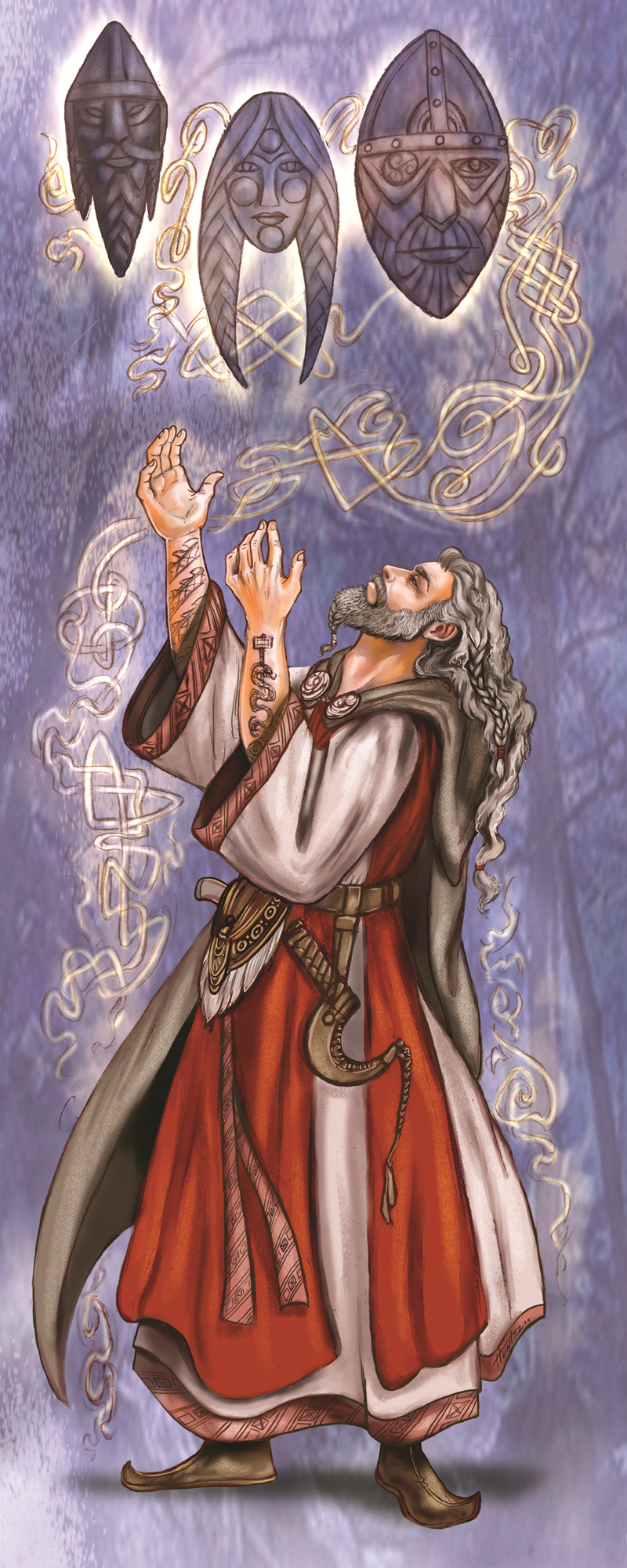
The Norse gods worshiped in Iceland are well-known to most people: the All-Father Óðinn (Odin); his son, the storm god Þór (Thor), the trickster Loki, and others. Heroes in Icelandic sagas pay heed to these gods and others, and base their behavior and codes of conduct on what the gods would and would not find acceptable or venerable. Most Icelanders worship multiple gods but tend to venerate one above the rest, considering that god their patron. Your hero starts play with 3 dedication points affiliated with their patron god, a measure of how strongly they worship that god. When your hero prays to their god for assistance, asks for a blessing, or otherwise acts in accordance with that god’s ideals they can spend one or more dedication points. Spending a dedication point does not require a roll on its own: they modify the chance of success for any ability roll your hero attempts.
- 1 point adds +20% to one ability.
- 2 dedication points add +30%.
- 3 dedication points add +50%.
Dedication points are recovered with a successful Worship (deity) roll at a worship ceremony or ritual, after making a sacrifice, or while visiting a temple or site holy to that god. This is outside the scope of the quickstart.
Power and Wyrd
The Power (POW) characteristic represents resilience and strength in a hero’s soul and spirit, their luck, and the battery for any magical powers they might have. POW is, quite literally, a hero’s destiny and the control they have over their own fate. A hero can call upon Wyrd to cheat fate, at least temporarily. By permanently reducing POW by 1, a hero turns any failed roll into a success, calling upon destiny and causing the world to bend to their will. This can only be done once per day. However, fate always exacts a price, which eventually comes due. A hero with very low POW is luckless and weak-willed, knowing their death is close at hand. They can feel fate closing in on them, their destiny ending. They find themselves shunned by others, seen as an omen of impending doom and misfortune. At 0 POW, the hero lacks the will-force to live, and they expire, forgotten, perhaps even denied an afterlife.
Circumstances
The circumstances surrounding your hero when they make skill rolls can dramatically affect their chance of success, to say nothing of potential rewards for success or consequences for failure. The gamemaster can modify skill percentages based on your hero’s immediate situation or other circumstances.
Skills
Each skill has a rating representing your hero’s chance of successfully using that skill, expressed as a percentage rating. The Age of Vikings core rules offer more skills, including magic.
Combat
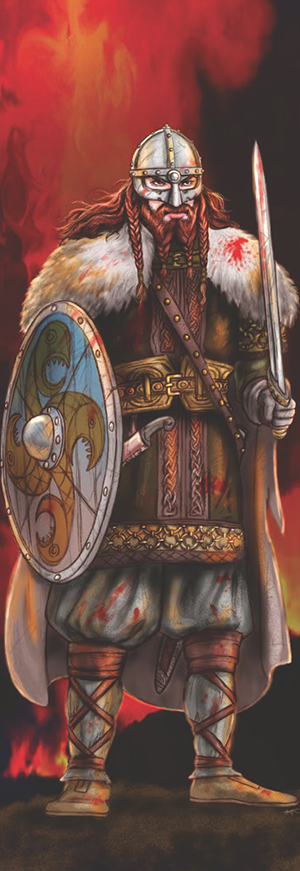
Combat can be brutal and wild, a flurry of actions and conflicting goals. Any blow might be fatal, with only one’s war-gear and skill to prevent death from striking at any moment. Combat rules bring order to that chaos: making it tactical and easy to participate in, but also letting those with superior skill and strategy dominate.
These rules are summarized from the Age of Vikings core book, simplified for ease of play.
The Combat Round
The flow of action in an encounter is measured in an abstract unit of time called a combat round. A combat round doesn’t have an absolute or fixed length but is usually around 12 seconds (five combat rounds equal a minute). A combat round is long enough for a hero to do something significant enough to change their circumstances or tip the balance in their favor.
Action Order in a Combat Round
Combat actions are resolved in order of highest Dexterity (DEX) to lowest, though sometimes a hero might take a penalty to their DEX and act later in the combat round if they wish to perform certain actions. When DEX ratings are tied, check each participant’s Intelligence (INT), with the highest INT acting first. If participants’ DEX and INT scores are tied, their actions occur simultaneously, but heroes get to declare their action and roll first. If two heroes are tied, let them decide who acts first.
Engaging
To engage another combatant, move within 1 meter of them with a weapon drawn and with the intent to do them harm.
Movement
A hero may move up to their movement rate (MOV) in a combat round. For humans, MOV is always 10 (though it might be modified by magic or other circumstances). Each point of MOV represents 1 meter (about 3 feet). Movement more than a few paces in any direction (around 1 meter) costs the combatant time in DEX, A combatant should only move once per round.
Attacking in Combat
During combat a hero can strike at an opponent with a weapon, usually to deal damage.
To attack, make a skill roll with the relevant skill according to the weapon your hero is using. If you succeed (by rolling equal to or less than the skill rating), you hit your target. Your opponent can choose to dodge, parry, or neither. If your target dodges, they make a skill roll using Dodge. If they succeed, they evade your attack.
Once you’ve hit your target with a blow that was not parried or dodged, roll a D20 on the target’s hit location table to determine where your blow landed.
Now roll damage dice for your mode of attack. A critical success doubles the damage that you roll (but does not double the damage modifier roll). The target subtracts their armor’s protection value and then suffers the remaining damage. If the location’s hit points are reduced to 0, the hit location is disabled. The target may suffer additional effects based on the hit location struck.
Defending in Combat
If your hero is close enough to strike an opponent with their weapon, they’re close enough to strike back. When attacked, your hero has several options to choose from
First, you can dodge.
- Make a Dodge roll. If you succeed, you evade the attack and take no damage.
- If your opponent’s attack was a critical success (they rolled equal to or under 10% of their attack value) and you successfully dodge, that attack becomes a success instead of a critical success.
- A critical dodge blocks a critical attack, and a critical dodge evades a critical attack.
A combatant attacked by multiple assailants must dodge each attack individually. Each attempt to dodge an attack after the first is made at a –20% cumulative penalty.
Second, if wielding a weapon or a shield, a hero can parry an attack against you that uses a melee or thrown weapon (but not a ranged weapon like a bow).
- Choose what you want to use to parry (a weapon or shield) and make a skill roll using parry. If you succeed, you parry the attack and take no damage.
- If your opponent’s attack was a critical success (they rolled equal to or under 10% of their attack value) and successfully parry, that attack becomes a success instead of a critical success.
You cannot try to both dodge and parry the same attack: choose one or the other.
If a combatant is under attack from multiple assailants, they must parry each attack individually. Each attempt to parry an attack after the first is made at a –20% cumulative penalty.
Alternatively, you can choose to do nothing, suffering the attack and hoping that it is not fatal.
Disengaging
You can always disengage from a combatant that is willing to let you leave by simply moving away from them, but if they aren’t so inclined, there are three ways to disengage:
- First, you can retreat. On your turn, declare your intention to retreat, taking no other action, and move away from your opponent (following all other rules for movement). While retreating, you can dodge and parry as normal but cannot act in any other way aside from withdrawing from your foe.
- Second, you can try to push your enemy away from you with a knockback attack. On your turn, declare your intention to perform a knockback attack. Make opposed rolls of your STR×5 vs your
opponent’s STR×5. If successful, you knock your opponent back 1D3 meters, and you are disengaged. If the foe wins the roll or the roll is a tie, you stay within their reach. If your roll is a critical success, your foe is knocked prone instead (attacking a prone foe is at +40% to the chance of success, and attacks while prone are at a –40% chance of success). - Finally, you can try to flee. Fleeing is different from retreating in that retreating is controlled and careful, while fleeing is reckless and leaves you defenseless. If a combatant flees from engagement the foe can make one immediate attack against them which cannot be dodged or parried. Otherwise, the fleeing character can move and act as normal.
Damage and Hit Locations
If you’ve been hit, or when you successfully hit an opponent, roll a d20 to determine where the blow landed. Check the hit location diagram, reduce the damage by any armor protection in that location, and then subtract the remaining damage from that location’s hit points as well as the being’s total hit points.
Hit locations for heroes appear on their hero sheets and look like the 'HIT LOCATIONS' picture (opposite).
When any of a living being’s hit locations has been reduced to 0 or fewer hit points, it becomes disabled.
- Leg: Your hero falls prone but can still fight, taking –40% penalty to attacks and parries. Enemies gain +40% to attacks. You cannot dodge.
- Abdomen: Your hero falls prone and begins bleeding. They will die within 10 minutes without healing.
- Chest: Your hero is incapacitated and begins bleeding. They will die within 10 minutes without healing.
- Arm: Your hero drops whatever they were holding in that arm but remains standing. Your hero cannot use any two-handed items with one arm incapacitated.
- Head: Your hero is unconscious and will die within 5 minutes without successful medical care from someone else.
When your hero has been reduced to 2 or fewer total hit points, they fall unconscious. When your hero has been reduced to 0 or fewer total hit points, they die at the end of the round unless given enough First Aid to restore them to 1 hit point.