As Viking heroes adventure throughout the greater world beyond the shores of Iceland, they will inevitably come into contact with foreign foes wielding new weapons and armored differently than they are. Because the principles of using these weapons are immediately obvious, and armor serves the same purpose no matter what it is fashioned of, heroes may end up taking some of these foreign arms and armors for their own, perhaps bringing them back to Iceland as spoils or personal gear.
Presented in this article are a variety of new and potentially uncommon weapons heroes might encounter and take for their own, as well as some commonplace weapons found everywhere, including in Iceland. The Age of Vikings core rulebook includes foreign combatants but generally arms and equips them with the equivalent of weaponry and armor used in the Norse world. The Age of Vikings Companion contains additional foreign opponents and follows the same tradition, but entries in the section on foreign heroes provide alternate weapons. If desired, the gamemaster can equip opponents with these new weapons provided here.
As a note, several of these weapons are drawn from sagas—inevitably written by non-warriors, much after the events portrayed, and inconsistently translated—or from scarce historical records. Sometimes multiple words describe the same weapon, and at other times the same word describes different weapons, occasionally incorrectly. For example, a weapon described as being thrown may not have been made for throwing at all, and was simply thrown in a saga as an act of opportunity or desperation. Or that use might have been invented entirely by the storyteller.
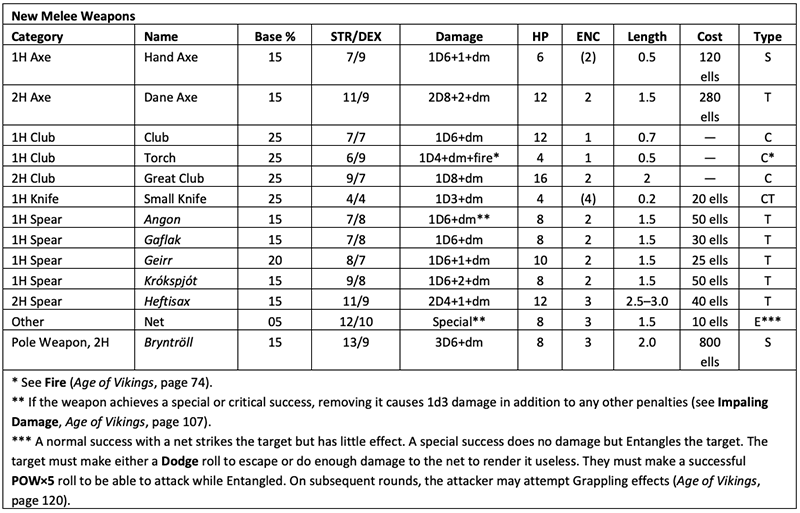
New Melee Weapons
Angon: An antiquated type of light spear with a barbed point, this was hurled like a javelin at a foe, after which the head would become embedded in flesh, causing considerable distress. Though use largely disappeared in the Norse world by the 7th century, these were used occasionally by Franks and others of Germanic descent.
Bryntröll: Also called a höggspjót, the bryntröll (“mail-troll”) is a heavy-bladed, short-handled halberd.
Club: A heavy piece of wood roughly the length of a human forearm or arm. Used with one hand. Irish warriors sometimes use lighter versions made from lengths of blackthorn wood with root-knob heads, called shillelaghs. This could also describe an oar or a whale bone.
Dane Axe: Essentially a longer-hafted long axe with a wider, almost triangular blade.
Club, Great: A longer-hafted club, usually longer than a meter (3.25+ feet) long, used with both hands.
Gaflak: A javelin, also called a spjótsprika (“puny spear”).Though primarily used as a missile weapon, it can also be used hand-to-hand.
Geirr: A simple one-handed spear, usually wielded in tandem with a shield. May be thrown in desperation or as an opening volley in a skirmish.
Hand Axe: Sometimes called the francisca, named by and for the Franks, this is a small one-handed axe, often used as a backup weapon. Balanced for throwing, many warriors to carry two or more of these tucked into their belt or girdle, hurling them before an engagement and sometimes keeping one as a reserve weapon.
Head Butt: Using a skin-covered knob of bone—one’s head—as an improvised club.
Heftisax: A long, pike-like spear, also called a fleinn. Much longer than most spears, these are almost always used as two-handed spears and thrown by stronger warriors.
Krókspjót: A barbed spear, usually with a long, thin blade giving way to two wings. Some of these spears have back-pointing spikes like an angon (above) while others have wings projecting straight to either side of the socket.
Net: A sturdy net, as used in fishing, can be used as an improvised weapon to capture or subdue a target without harming them directly.
Rock: Many are the fights settled with a fist-sized rock, held in the hand and used to club someone to death.
Small Knife: Also called a belt knife or even an eating knife, this is an extremely short and narrow-bladed knife, usually worn openly at the belt.
Torch: A light length of wood, often with the head wrapped in cloth and soaked in pitch and set aflame. A poor choice for a weapon but often used in desperation.
New Missile Weapons
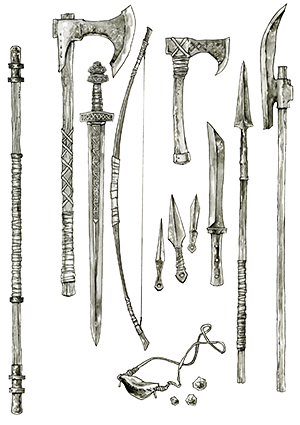
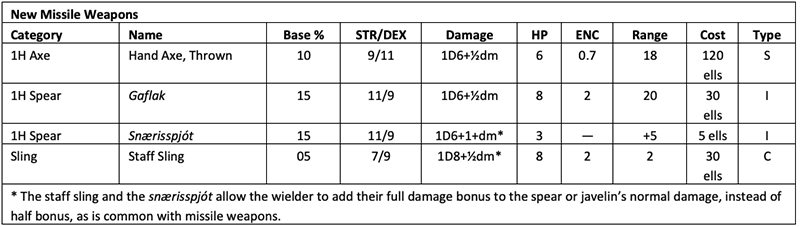
Gaflak: A javelin, also called a spjótsprika (“puny spear”). Primarily a thrown weapon.
Hand Axe, Thrown: The hand axe or francisca, described above, is commonly used as a missile weapon, thrown before engaging in melee combat. It has a short range, and can be used as a backup hand weapon if necessary.
Snærisspjót: A “throwing-string” for a spear, this is a thin strap used under the butt of a spear and used like a sling tohurl the spear or javelin, adding additional force and range. These are used by Norse, but not often in skirmishes.
Staff Sling: Called the fustibulas in Latin, a staff sling consists of a sling set onto a staff, able to throw a stone with tremendous force. These have greater range and are able to handle heavier projectiles, and can double as quarterstaves inclose quarter fighting, but are not as portable or easy to use as normal slings
New Armors
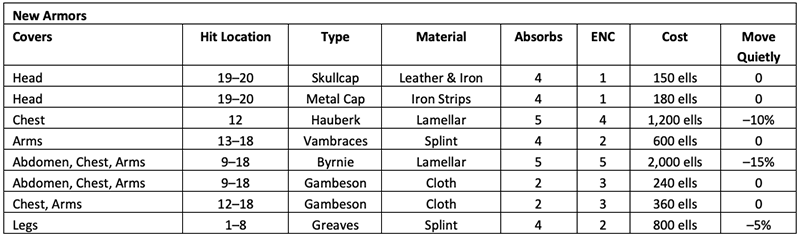
Hauberk and Byrnie (Lamellar): Made of metal plates, often squared or rectangular, this form of armor was relatively common elsewhere in the world but some Norse warriors adopted the fashion, either using found armor or making it locally. The further eastward one goes on the mainland the more likely this armor is to appear. Lamellar can be worn as byrnies (fully covering the chest, abdomen, and partially covering the arms) or as hauberks (covering only the chest).
Gambeson (Quilted Cloth): While Age of Vikings includes cloth armor (page 116), another type of armor was common on the mainland, the quilted gambeson, a heavy linen and/or wool sleeved jacket either ending at the waist or extending down to cover the abdomen and thighs. Some Norse called them vápntreyja (“weapon-shirt”).
Helmets (various): Age of Vikings presents wool and leather caps and iron helms (page 116), usually consisting of a metal skull cap with metal goggles, ear protection, and/or a nasal guard, other types of helm are commonly worn on the mainland. These include conical helms made of multiple iron pieces fastened to a leather base or to an iron frame, simple one-piece metal padded skullcaps, and even helmets made of interwoven iron strips shaped to cover the skull.
Splint Armor: An older form of armor favored by Scythians several centuries ago and later adopted by Swedes in the Age of Vikings period, splint armor consists of long metal straps affixed in parallel to a leather sleeve, usually sewn onto a chain hauberk, or sewn onto pant-legs as lower leg protection
Armor and Arms
The standard Icelandic chain mail shirt is a hauberk, a short-sleeved tunic that extends downward to cover the groin and extends just past the shoulder muscle and partway down the upper arm. Chain tunics made in other places and later times often have longer sleeves, sometimes even partially covering the hand. At the gamemaster’s discretion, a chain tunic used by player heroes can be considered to be one of these longer-sleeved variety, allowing coverage of the majority of the arms.
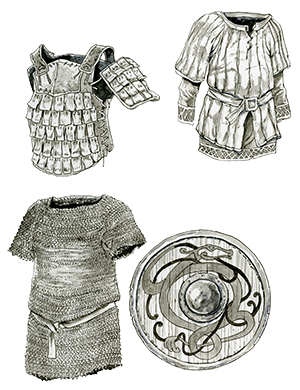

Chain sleeves are not used as separate pieces of armor, but some Swedish Vikings and warriors use splint vambraces and greaves (described above) to protect their arms and legs.

